Professional Title/s
Associate ProfessorFaculty Credentials
B.S., University of Illinois at Urbana Champaign, M.S., Michigan State University, Ph.D., University of South FloridaBiographical Information
Teaching
Investigative Approaches in Biology, Organismal Physiology and Ecology, Marine Biology, Comparative Anatomy
Research
Paleobiology, Biomechanics, Anatomy
Research Interests
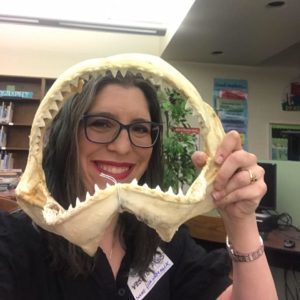
My general research interest is on the evolution of shape. My main focus is on functional morphology, the relationship between form and function, in extinct and extant organisms. My primary tool for this is biomechanics, the application of engineering techniques to determine how organisms perform mechanical functions, the design of morphological systems, and the relationship of these to the organism's environment. I also use shape as a diagnostic tool for species delimitation in the fossil record via geometric morphometrics, as well as determining paleoecological relationships. My research has historically concerned teeth and jaws of sharks and other fishes, the biomechanics of marine gastropods and their predators, and jumping mechanics of salamanders.
Potential comp projects in my lab could concern invertebrate or vertebrates; extinct or extant; biomechanics, morphometrics, or paleoecology. Previous comp topics in my lab include sexual dimorphism in macaque monkeys and great horned owls, northern pike bite force, bluegill feeding kinematics, and biomechanics of various aspects of locomotion in fishes, lizards, frogs, salamanders, and humans. Visit my personal site for a complete list of comps from my lab.
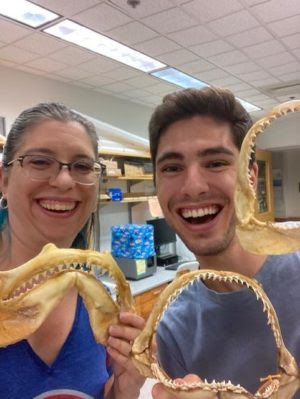
Ryan Sessler ’23 and Associate Professor of Biology & Geology Lisa Whitenack presented their summer research “Chomping at the bit: the effects of wear on shark tooth puncture performance and morphology” at the Society for Integrative and Comparative Biology annual meeting on Jan. 6, 2022.
Sessler examined the puncture forces and degree of wear in shark teeth from bull sharks, blacktip sharks, and sandbar sharks in fish prey. Forces and wear were measured over a series of 400 punctures per tooth, but the effects were seen as early as 20 punctures into the series. Some sharks can replace their teeth every few weeks, and these preliminary data suggest that it may be due to tooth wear. Sessler will use this preliminary data as the basis for his Senior Comp next year.
More Information
Office Hours
- Monday: 8:00 - 9:50 am
- Tuesday: None
- Wednesday: 8:00 - 9:00 am, 2:00 - 3:00 pm
- Thursday: 11:00 - 12:00 pm, 3:00 - 4:00 pm
- Friday: None
Contact for an appointment