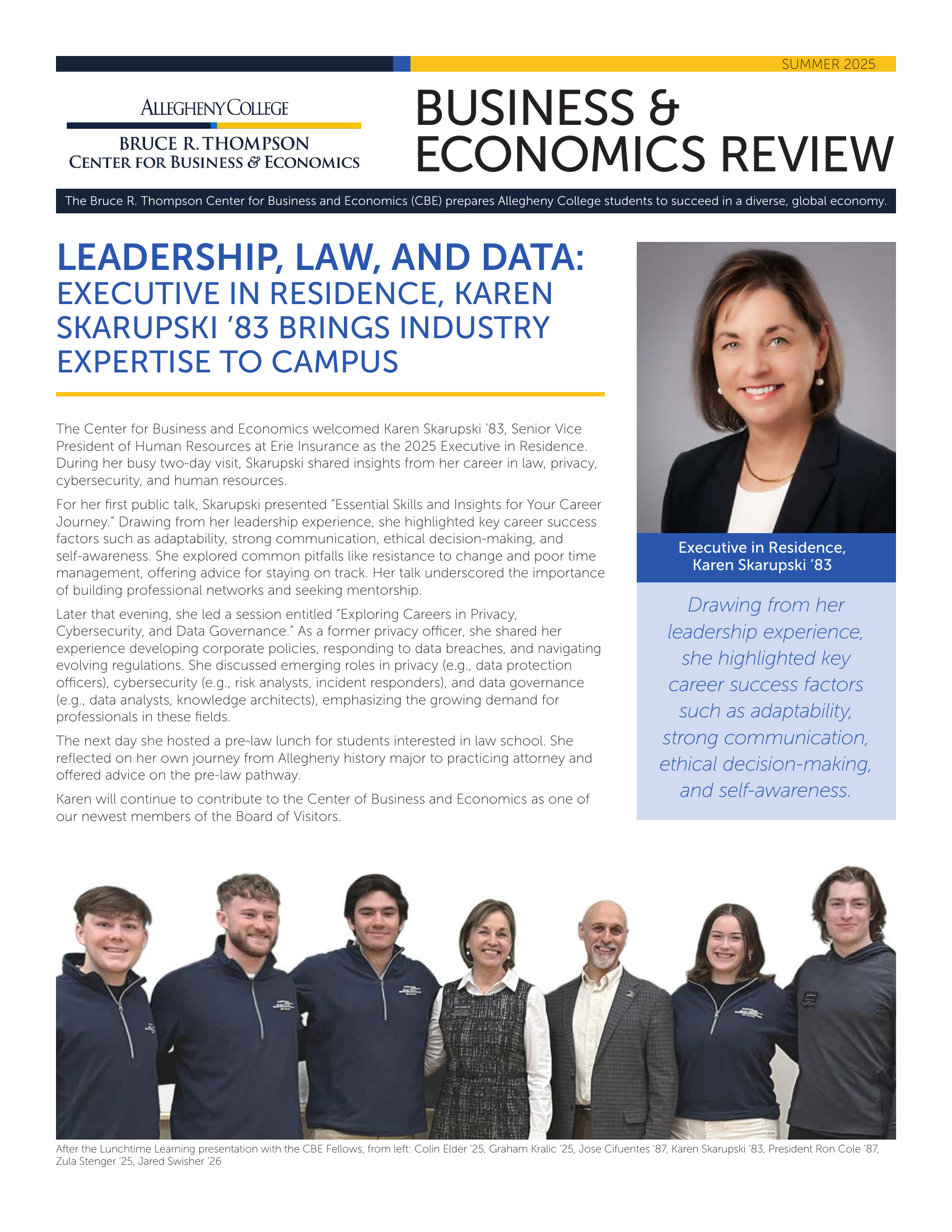
Our Summer 2026 newsletter is now available with stories of student achievement, community engagement, faculty excellence, entrepreneurship, and alumni success. From helping local taxpayers through the VITA program to competing in the Zingale Big Idea Competition and presenting research at the Federal Reserve, our students continue to make a difference both on and off campus.
Take a few minutes to see what our students, alumni, faculty, and friends have been accomplishing.
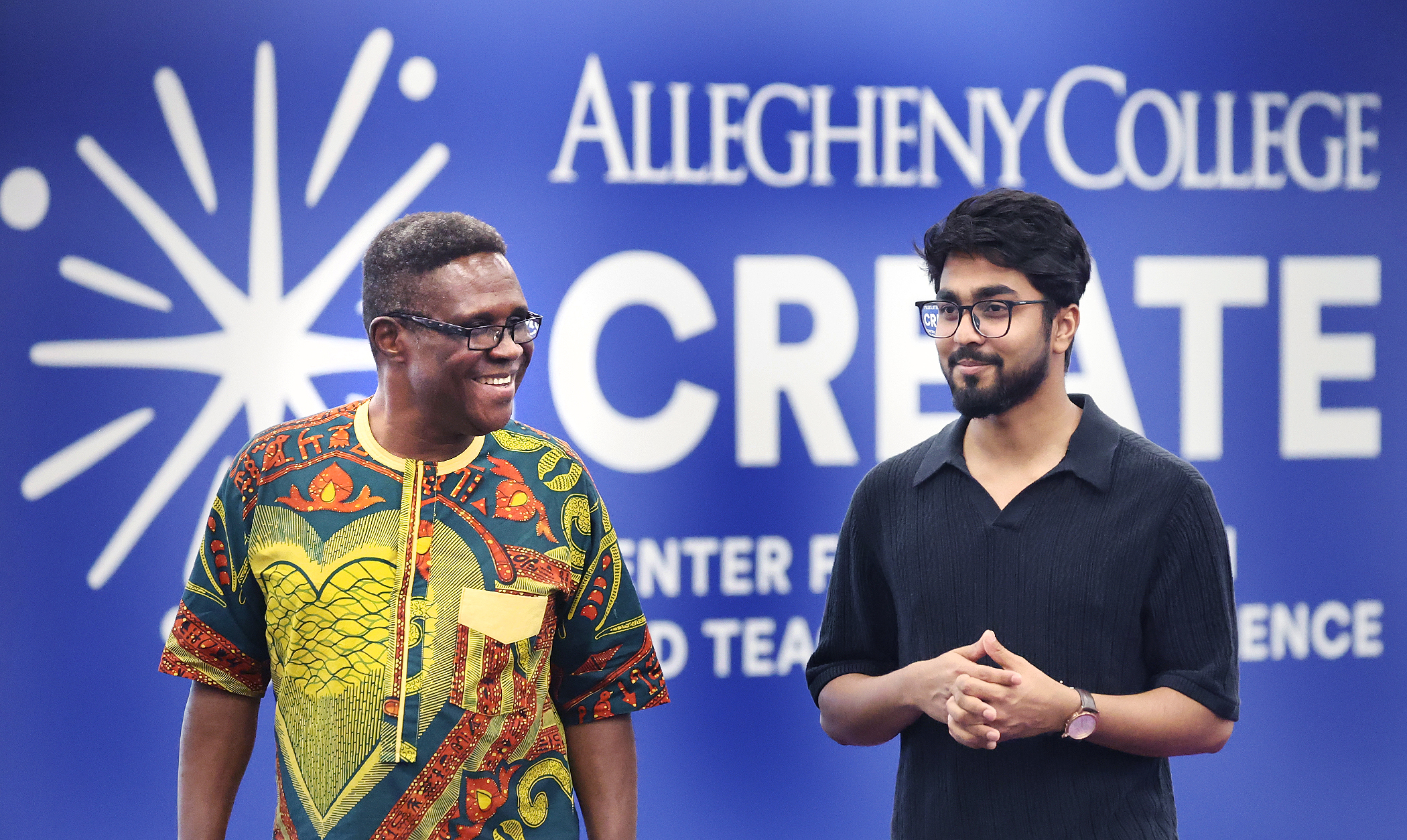
Allegheny College hosts weekly Tuesday luncheon featuring reports by ACRoSS summer student scholars: Yogesh Kumar Gupta ‘28 – Faculty Mentor: Prof. Steve Onyiewu. Photo by Ed Mailliard.
Yogesh Kumar Gupta ‘28, an International Studies and Economics Major, presented “Thinking Outside the Box: How Rwanda and Tanzania are using Industrial Policy to Foster Structural Transformation” during the summer Undergraduate Reasearch ACRoss Luncheon in the Pelletier Library. Under the guidance of faculty mentor, Professor of Economics, Stephen Onyeiwu, Yogesh explored the economic data on these two countries, and the options they have to develop economically.
To learn more about this research, we asked Yogesh to explain the background for this project:
Yogesh: Rwanda and Tanzania face socio-economic challenges that include low GDP per capita, high poverty rates and lack of structural transformation. Both countries have set ambitious goals designed to transform their economies, from low-productivity and subsistence agriculture to more diversified industrial economies. They have undertaken a plethora of industrial development initiatives during the past 15 years or so to foster inclusive economic growth and structural transformation.
This paper discusses how Rwanda and Tanzania have pivoted from the classic Import-Substitution Industrialization (ISI) strategy, to strategies that build on their respective dynamic and static comparative advantages. While Rwanda has sought to develop dynamic comparative advantage in knowledge and technology products, Tanzania has focused on leveraging its static comparative advantage in natural resources and minerals. In both strategies, the overarching goal is to achieve international competitiveness, contrary to their previous ISI strategy. The paper presents preliminary evidence about the outcomes of these industrial development strategies and offers some policy recommendations.
How did you arrive at your research question?
Yogesh: My initial stage in the research involved analyzing the socio-economic challenges facing Rwanda and Tanzania. This meant examining data on their development gap, including per capita income, which sits below the Sub-Saharan Average (SSA), and poverty rates, which are higher than both the world average and East Asian Countries. In both countries, subsistenceagriculture accounts for a significant share of employment, and 90% of employment is in the informal sector. This pointed to a clear conclusion: overcoming these challenges requires structural transformation, a shift from low-productivity subsistence agriculture toward higher-productivity industry and services. But how could this be achieved? While there are multiple pathways to structural transformation, our research focused specifically on the role of industrial policy as an impetus for it. To make sense of industrial policy, I began a literature review and found newer policy approaches outlined in World Bank reports. Industrial policy, as defined by the World Bank, is a strategic government action aimed at increasing a targeted business activity.
This was not the first time these countries had turned to industrial policy. They did so from the 1960s to the mid-1980s, when they adopted Import Substitution Industrialization (ISI), in which foreign investors and donors were expected to play a major role. Protective measures, including tariffs and other measures were put in place to shield domestic firms from foreign competition. This did not prove effective due to weak implementation, resulting in heavy government subsidies and protection the government could not sustain. As a result, state-owned enterprises collapsed, and foreign firms exited due to unfavourable business and regulatory environments.
To shore up their industrial performance, Rwanda and Tanzania implemented structural adjustment programs in the 1990s that included a reversal of the statist industrial policies of the 1960s-1980s. The liberalization of trade and investment characterized this era. Many of the restrictions on foreign investment were either eliminated or relaxed. But their industrial performance hardly improved. Despite those reforms, Rwanda and Tanzania found themselvesin a bind; they needed industrial development to achieve structural transformation, but market-based neoliberal reforms did not deliver it.
This bind didn’t go away; it just took a new shape. Beginning in the 2000s, both countriesreturned to industrial policy, but not the version that had failed them before. Rwanda, pursuingits goal of becoming an upper-middle-income country by 2035, and Tanzania, pursuingsustained economic growth, each adopted more selective, outward-oriented approaches: targeting specific sectors for export competitiveness, and often tying government support to firm performance, rather than offering blanket protection as before. This shift mirrors a broader global trend. Countries worldwide are returning to industrial policy; China, for instance, is using it to become a leader in semiconductors and vehicles, and the United States is enacting the CHIPS Act to counter global supply chain vulnerabilities, reduce reliance on foreign manufacturing, and strengthen national security.
But a return to industrial policy is not the same as a solution. The 1960s- 80s experience already showed that industrial policy can fail, not for lack of ambition, but through weak implementation and unsustainable burden. This raised the question I could not ignore: If industrial policy is once again the tool of choice, is it actually built to work this time, and howwould we know?
That question shaped my research:
What tools of industrial policy are African countries using to foster industrial development?
How effective have those tools been in promoting industrial development and structural transformation?
What surprised you once you got into your topic?
With similar starting conditions and economic structure, I expected Rwanda and Tanzania to pursue similar paths toward structural transformation. But this wasn’t the case, as their approaches to industrial policy were positioning the countries differently for the future.Rwanda’s industrial policy centred on building a knowledge-based ecosystem that has set the country on a faster path to structural transformation and gaining a dynamic comparative advantage. Tanzania appeared to pursue a more static comparative advantage, anchored in resource-based strategies to what it already has, rather than what it could build. This mattered more than I expected: Rwanda’s approach seemed to position it to tap into the fourth Industrial Revolution (4IR) and attract more forward-looking FDI, a notably ambitious strategy for a developing economy. At the same time, Tanzania’s strategy risked reproducing the same resource dependency it had once tried to escape.
How accessible was the data that you required to answer your research question given the history of violence in Rwanda in particular?
Data for Rwanda was more accessible than for Tanzania. With its strong bureaucratic structure, Rwanda has invested heavily in building a robust statistical and data-reporting system as part of its broader development strategy. We drew data from the World Bank country reports and the IMF, and conducted our statistical analysis using World Bank development indicators. Since our research specifically focused on industrial policy and structural transformation, we did not engage with materials related to Rwanda’s history of violence, as that fell outside the scope of our analysis.
Summer Research at Allegheny
Allegheny’s curriculum of developmentally appropriate undergraduate research experiences serve as the spine of our award winning research program. The Office of URSCA further supports and engages students outside of the classroom by funding collaborative Student-Faculty Research (SFR) projects during the summer.
ACRoSS
ACRoSS has become a flagship summer experience for all students and faculty members that are on campus during the summer. ACRoSS is an interdisciplinary forum for the presentation of summer research projects developed by students and faculty at Allegheny College.
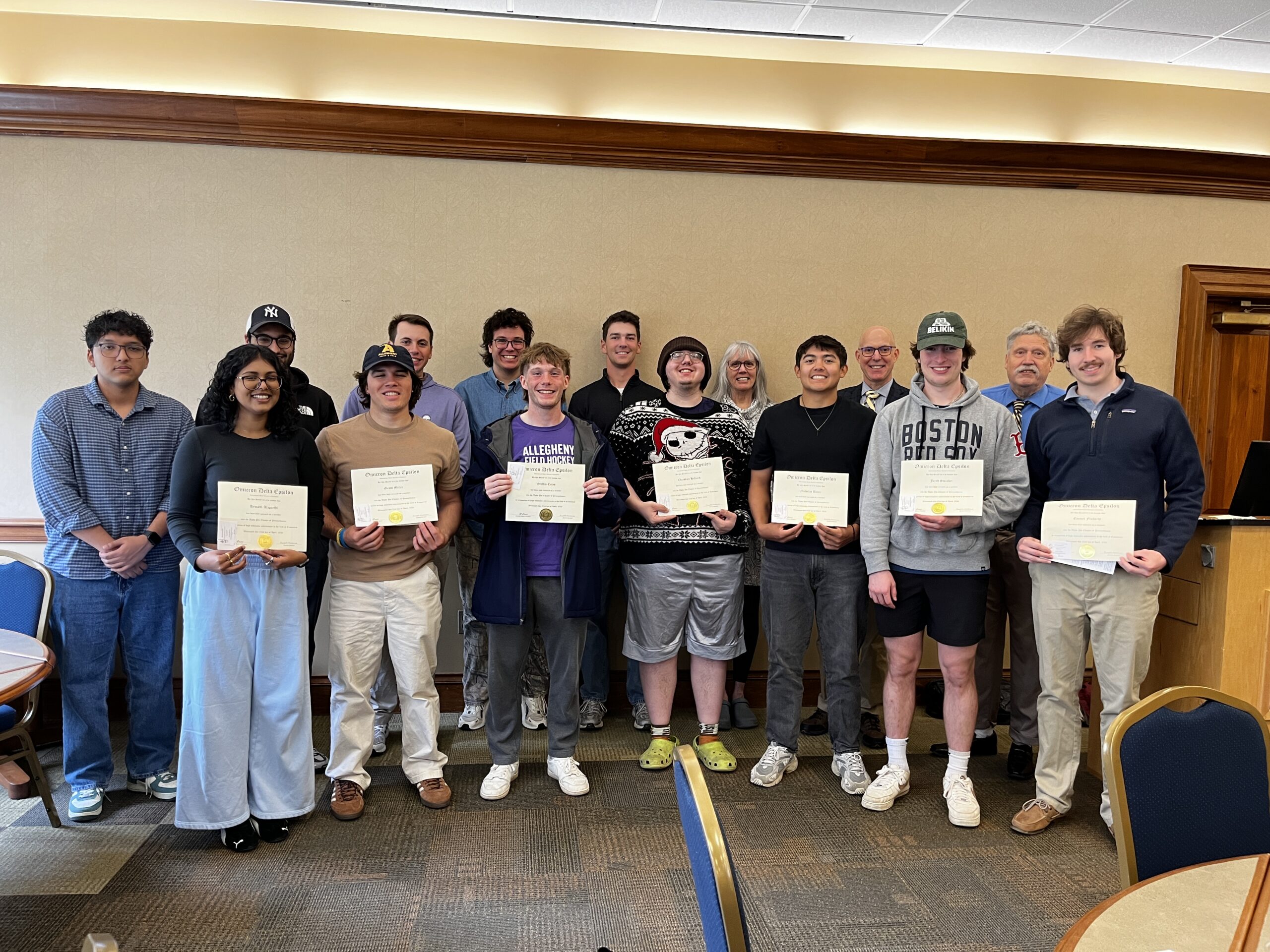
We’re excited to welcome the newest members of the Allegheny College chapter of Omicron Delta Epsilon Honor Society.
Omicron Delta Epsilon (ODE) is the international honor society recognizing excellence in economics. ODE honors outstanding academic achievement while encouraging scholarship, leadership, and service, supporting members as they grow in their studies, careers, and communities. Membership is more than an accolade—it’s a lifetime credential that reflects dedication to economics and connects students to a global network of peers, faculty, and professionals.
Here are this year’s newest members:
Hemani Alaparthi
Charlie Hutton
Emmet Fluharty
Sydni Junker
Tanner Miller
Dyllan Mbane
Christian Hilliard
Aiden McGrory
Duru Akbas
Gasparo Porco
Miguel Orti Vila
Grant Miller
Jared Swisher
Emily Hildreth
Griffin Cates
Ritesh Ojha
Samantha Mura
Nicholas Banez
Mikko Horlsey
Kylie Upton
Owen Nelson
Shayan Colabawalla
Cole Litman
Faculty Advisor: Jill Waugh, Assistant Professor of Accounting
Why Join Omicron Delta Epsilon?
Becoming a member of Omicron Delta Epsilon (ODE) is more than an academic achievement. It’s a lifetime credential that showcases your dedication to the field of economics and connects you to a global network of top students, faculty, and professionals.
With over 700 chapters worldwide, ODE offers opportunities to publish your work, apply for exclusive scholarships, attend academic events, and gain recognition that sets you apart in your academic and professional journey.
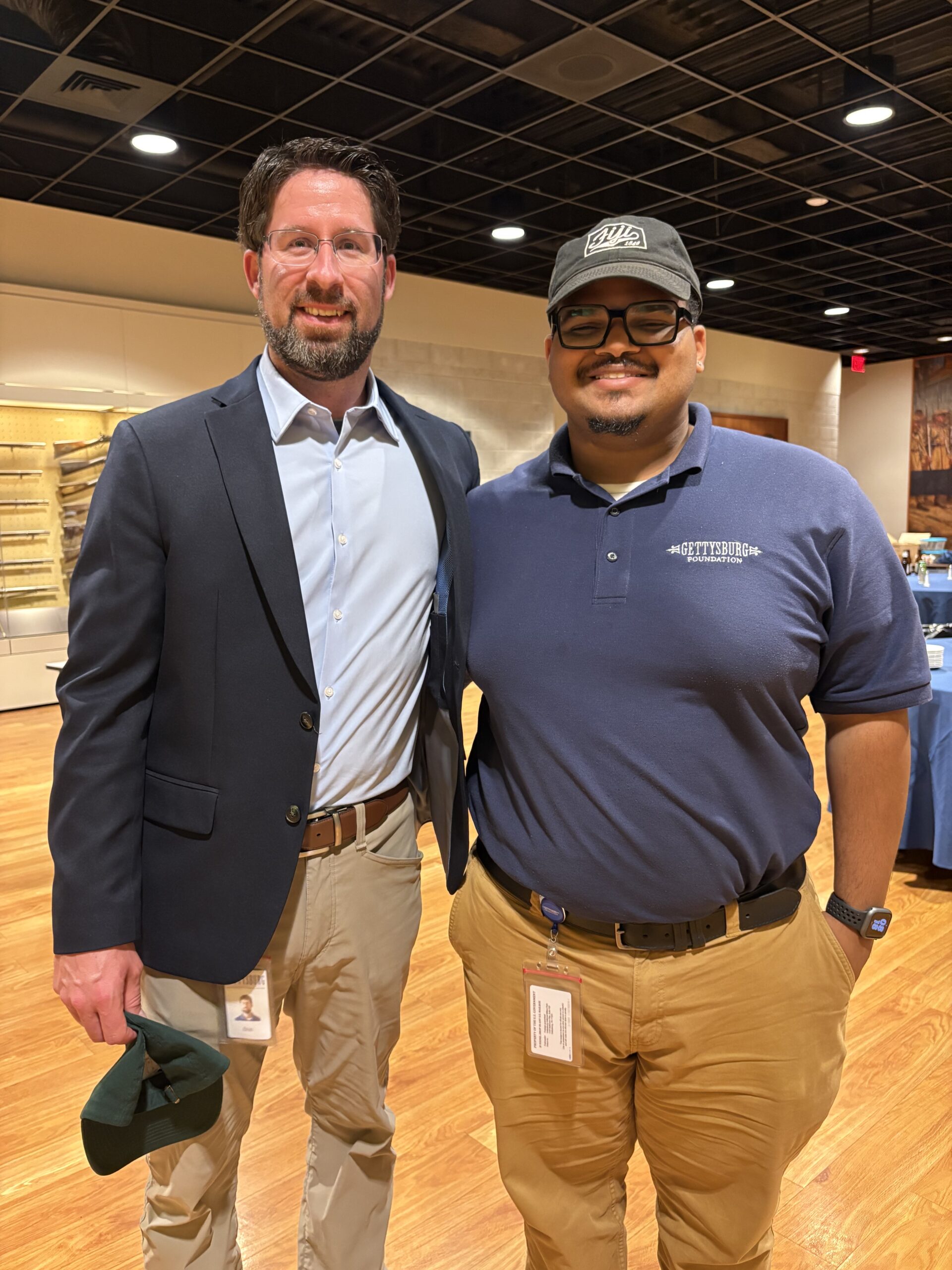
Left, Britt Isenberg, Gettysburg Foundation Vice President of Community and Civic Engagement with Logan Lee
The Internship experience that inspires research, professional growth, and a deeper appreciation for preservation.
Logan Lee ′26, a Business major and Communications & Media minor, spent an unforgettable summer at Gettysburg—the site where President Abraham Lincoln delivered his iconic Gettysburg Address. Through the Higher Ground Leadership Experience, Logan combined his academic interests with hands-on leadership development.
As part of his internship, Logan authored “The Economic Ramifications of the Gettysburg Battle,” published in the December 2025 edition of Preservation & Progress, a Gettysburg Foundation publication. His research revealed the staggering economic toll on local citizens, who filed hundreds of damage claims for livestock, crops, tools, clothing, and homes. Logan writes, “As the smoke cleared on Independence Day in 1863, Gettysburg faced an uphill battle to reach normalcy, reconciliation and peace.”
Carol Reardon ′74, Adjunct Professor of Civil War Era Studies at Gettysburg College commented, “During a quiet period for the Higher Ground Leadership Program that Logan helped to run this summer, the Gettysburg Foundation’s senior leadership challenged him to apply his economics and communication interests and skills to produce this [article]. Looks like he’s developing some history vibes, too!”
What inspired you to apply for the Gettysburg internship?
“I was encouraged by Professor Ishita Roy, who believed the program would be an excellent fit for me, and a valuable step in my professional growth. Their confidence in my potential really motivated me to apply, and I’m incredibly grateful that I did.”
What surprised you the most about spending the summer in Gettysburg?
“Honestly, looking back, the biggest surprise was the abundance of deeply passionate individuals who both work and live in Gettysburg. Their dedication to preservation, education, and public history was inspiring. Being surrounded by people who truly embodied the idea of ‘never working a day in your life’ because they love what they do made a lasting impact on me”
Would you recommend the internship to other Allegheny students?
“Definitely, my summer in Gettysburg helped me grow both professionally and personally. The combination of meaningful work, mentorship, and the historical environment shaped my skills, confidence, and long-term career interests. I would strongly recommend this internship to my fellow peers.”
About the High Ground Leadership Experience @Gettysburg
The Higher Ground Leadership Experience, offered by the Gettysburg Foundation, transforms historic lessons into modern leadership strategies. Through legacies from the Civil War, participants discover enduring lessons in leading under pressure, navigating change, aligning missions, and turning historical insight into actionable leadership strategies.
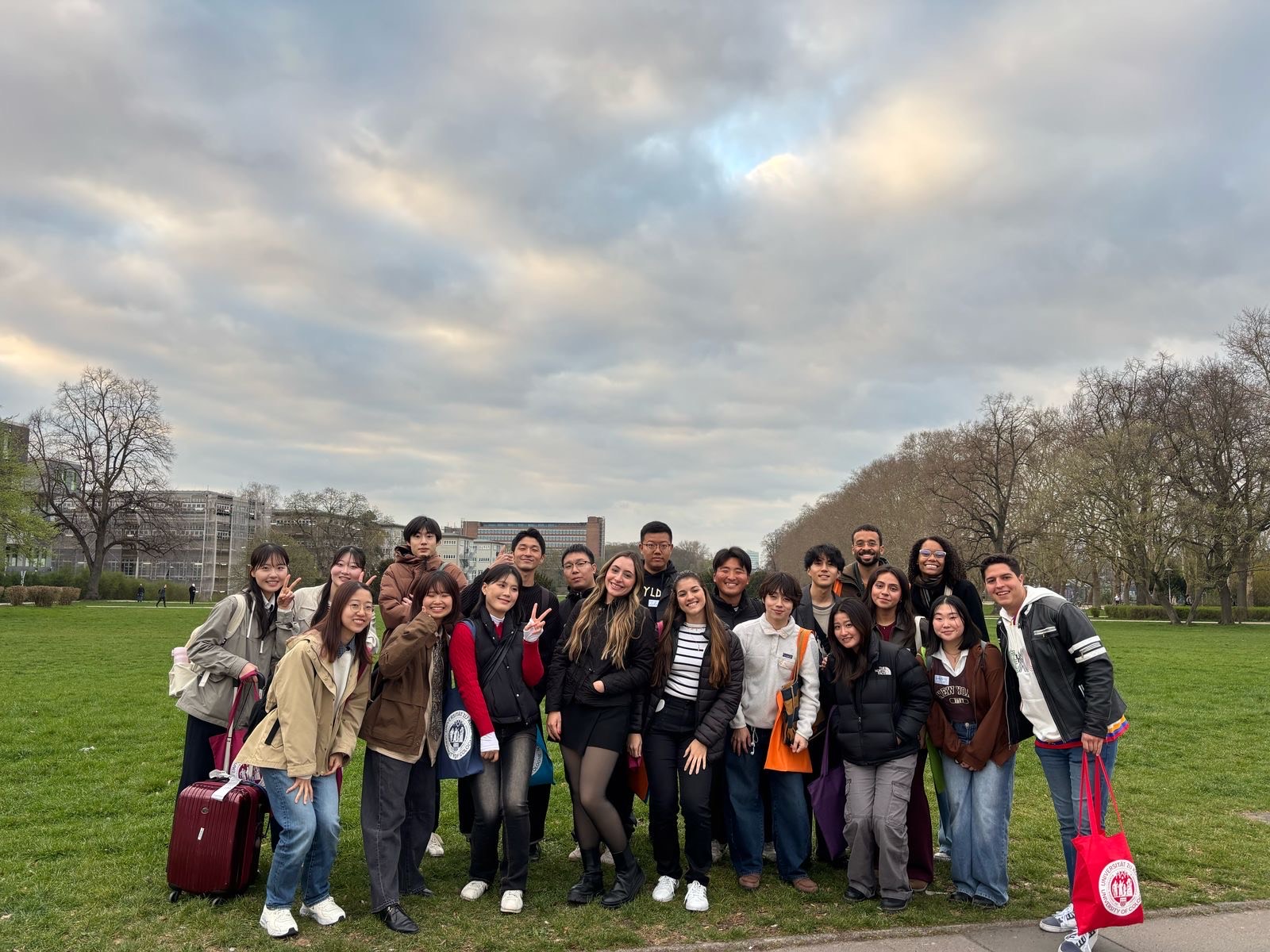
Lauren poses with her student cohort group in Germany
This summer, Lauren contintued her study away journey in Cologne, Germany. She is rejoining us on campus this fall and resuming her service as a CBE Fellow – we had to ask…
What was it like spending the summer in Germany?
Lauren: This past summer, I was overseas studying for a semester in Germany. It was a wonderful opportunity both academically and personally. Not only did I improve my German language skills, but I was also able to take a variety of courses in different disciplines. The experience allowed me to grow in an unfamiliar environment and meet new friends from around the world.
How did you discover this opportunity?
Lauren: Allegheny! I always knew I wanted to study abroad, and Allegheny provided that opportunity.The study abroad department was a great resource in making this experience happen.
What were your duties, or what did you study/learn/discover?
Lauren: As I mentioned, I took a variety of courses while abroad. These ranged from AI in German business to doing Indigenous Studies. I was also able to continue my studies in the German language, interacting with it firsthand with native speakers and those at my level. I also learned the culture and history of the city I lived in and the places I traveled to.
Would you recommend this opportunity to another Allegheny student?
Lauren: Definitely! It was not only a valuable academic endeavor but also a meaningful personal experience. I had to live on my own in a whole new culture, and I was able to grow because of it. It was very daunting at first, but I am so glad I took the chance and went. My advice is to do it if you are able to. It doesn’t matter where in the world you go, the experience and the people you meet are invaluable.
Lauren Schuch ’26 is an International Studies and Business double major. She serves as a CBE Fellow, Co-President of the Women in Business and Economic Club and an active member of the International Club.
The Bruce R. Thompson Center for Business and Economics (CBE) prepares Allegheny College students to succeed in a diverse, global economy.
A chance meeting at a student conference opened the door to a summer at Latin America’s largest investment bank.
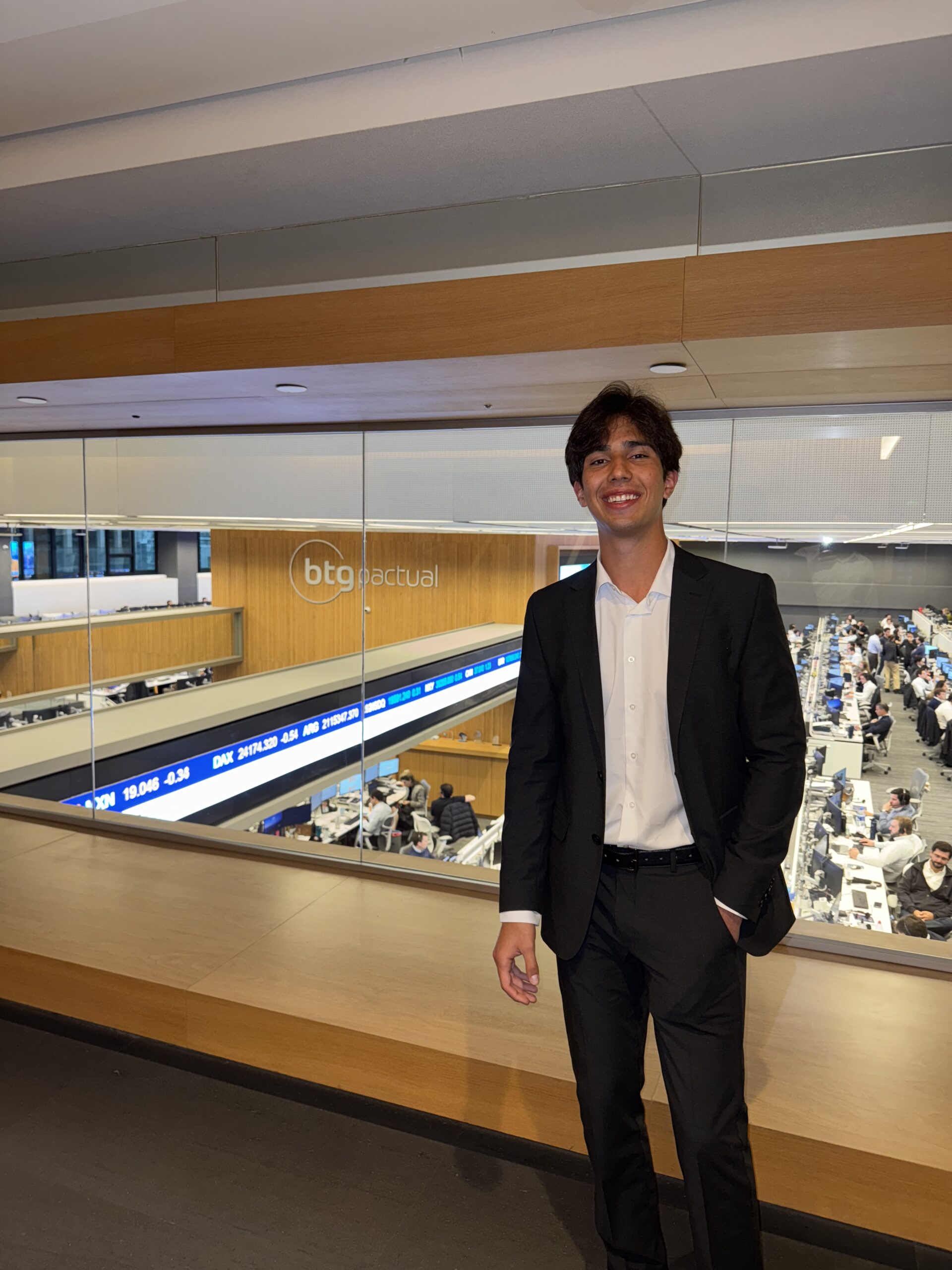
Gabriel Salvatore Xavier Saccoccio, a rising junior majoring in computer science and minoring in economics, spent his summer interning at BTG Pactual in Brazil after connecting with recruiters through the Brazilian Student Association’s annual conference. We asked Gabriel:
Where did you intern this summer?
This summer, I interned at BTG Pactual, the largest investment bank in Latin America. I worked with the IT Legal team to help modernize systems that manage thousands of legal cases involving the bank.
How did you discover this opportunity?
I discovered the opportunity through BRASA, the Brazilian Student Association, during its annual conference at Columbia University in October 2024. The event included a career fair that connects Brazilian students studying abroad with top companies, and it was a great chance to speak directly with recruiters from BTG.
What were your duties and what did you study/learn/discover?
I supported the IT Legal team on projects focused on improving how the bank manages its legal cases. My work helped streamline internal processes, making it easier for teams to track case updates, deadlines, and financial information. I collaborated with different departments and contributed to tools that made the bank’s legal operations more efficient and accurate. This experience gave me valuable insight into how technology supports legal and compliance work in a major financial institution.
Would you recommend this opportunity to another Allegheny student?
While the internship is tailored for Brazilian students, BTG does have branches in New York and Miami. I strongly recommend attending conferences that resonate with your interests, as they’re a powerful way to connect with recruiters and professionals face-to-face, which can lead to opportunities you might not find otherwise.
Gabriel serves the department as a CBE Fellow, speaks four languages and is a first place winner in the Financial Literacy Challenge. He will study away during the fall 2025 semester in Madrid, Spain.
The Bruce R. Thompson Center for Business and Economics (CBE) prepares Allegheny College students to succeed in a diverse, global economy.
Starting this fall, the Business and Economics Department is offering a new series of microcredentials designed to help students stand out in today’s competitive job and graduate school markets.
These digital badges recognize verified skills and competencies earned through existing coursework and hands-on experiences. The first four microcredentials — Accounting, Finance, Investing, and Tax Fundamentals — offers students tangible proof of their expertise in high-demand areas, from financial analysis to real-world tax preparation. By earning these credentials, students can demonstrate their readiness to employers and admissions committees alike, boosting their visibility and credibility in application processes that increasingly rely on data-driven hiring tools.
Accounting
The accounting microcredential provides foundational knowledge of accounting processes and methodologies. Students develop an understanding of accounting principles such as recording transactions, presenting financial information, and analyzing costs.
Finance
Finance equips students with the tools and methodologies employed by finance professionals. Upon completing this microcredential, students will understand the role of financial markets in the economy, how interest rates are determined, how risk affects the price and expected return of a financial asset, and will be able to analyze investment decisions.
Investing
Investing equips students with the tools and methodologies employed to value assets. Upon completing this microcredential, students will understand how risk and interest rates influence the pricing of financial assets, and will be able to generate reports on firms, including equity recommendations employed to value assets. Upon completing this microcredential, students will understand how risk and interest rates influence the pricing of financial assets, and will be able to generate reports on firms, including equity recommendation
Tax Fundamentals
The tax fundamentals microcredential provides a working knowledge of accounting fundamentals, tax law, and tax preparation. Students receive training and hands-on preparation experience by preparing individual tax returns and reviewing those returns over two semesters of the Volunteer Income Tax Assistance Internship. The first time the students take the internship, they are certified as Preparers, and the second time they are certified as Preparers/Reviewers.
For more information on our full list of microcredentials and their course requirements, visit the Academic Bulletin for 2025/2026
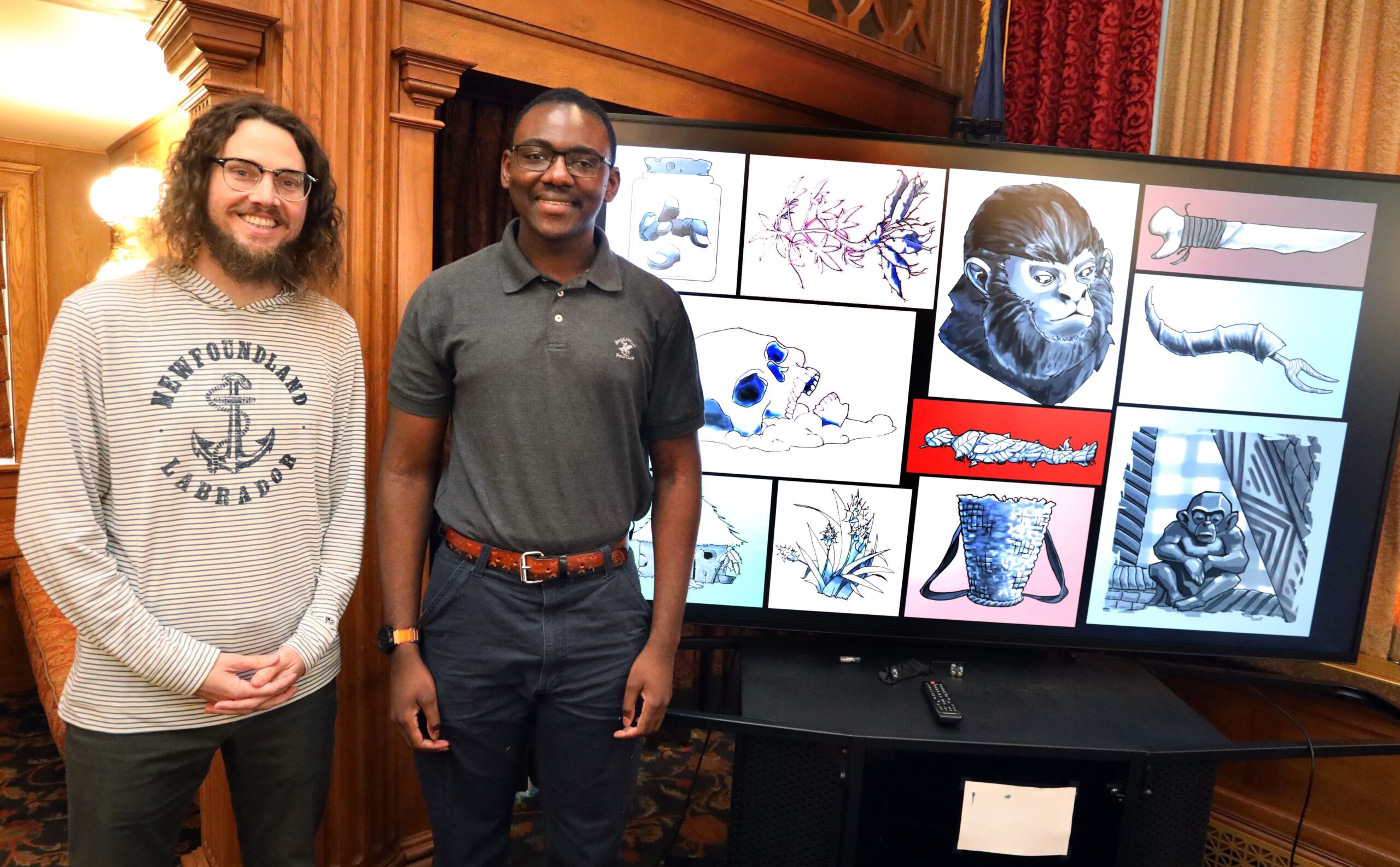
Assistant Professor Chris Finaret and Aldrich Simon ’27
Aldrich Simon ’27, a studio art and communication major, presented a short overview of his creative project, The Paper Bell: Graphic Noveling Economic Fiction at this year’s summer research seminar program (URSCA). The book he is illustrating blends storytelling with economic theory to create an illustrated companion novel for the course ECON 256: Economic Development.
Mentored by CBE Co-Director and Assistant Professor of Economics Chris Finaret, Aldrich is illustrating a 77,000-word work of second-world magical realism written to complement Why Nations Fail, the acclaimed book by 2024 Nobel Laureates Daron Acemoglu and James A. Robinson.
“In an effort to celebrate reading and reinforce course themes, I’m using a companion novel to enhance the understanding of Why Nations Fail,” said Finaret. “Entire passages in The Paper Bell are inspired by specific case studies from the text. It’s more than supplementing coursework with historical fiction—it’s reimagining how students engage with complex global issues.”
Set in a richly imagined world, The Paper Bell follows Kedi, a younger sibling who learns he’s not the main character, and the Witches of Lorango, the true heroes of a family saga rooted in survival, power, and change. According to Prof. Finaret, “Again, URSCA has created an opportunity for a student and I to enrich a project centered around teaching and art. Where else are students treated to bespoke economic fiction, tailored for their course and brimming with classy art by a student peer? Truly another expression in Allegheny College’s liberal arts tradition. I can’t wait to teach The Paper Bell in Economic Development this Fall.”
The novel will be privately published for classroom use, with a limited number of copies available at Tattered Corners bookstore in Meadville during the Fall 2025 semester.
This opportunity for student/faculty collaboration has been made possible through the Office of Undergraduate Research, Scholarship and Creative Activities (URSCA). URSCA’s mission is to promote student research, organize on-campus presentations of student projects, and provide information and support to students who present their projects off-campus. Learn more about URSCA at https://sites.allegheny.edu/undergraduate-research-scholarship-creative-activities/
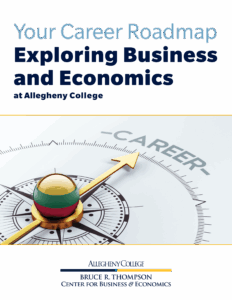
What can you do with a degree in business or economics? At Allegheny College, the answer is — more than you might imagine.
To help students explore the wide range of opportunities available—both during their time at Allegheny and after graduation—the Bruce R. Thompson Center for Business and Economics has developed a comprehensive Roadmap for Business and Economics Students.
This guide isn’t just about choosing a major—it’s about building a life. It’s designed to help students assess their skills and interests, set meaningful goals, connect with mentors, and make informed choices about internships, research, graduate school, and career paths.
Whether you’re a prospective student, a current Gator, or a proud alum looking to mentor the next generation, the Roadmap is filled with insights and tools to guide the journey.
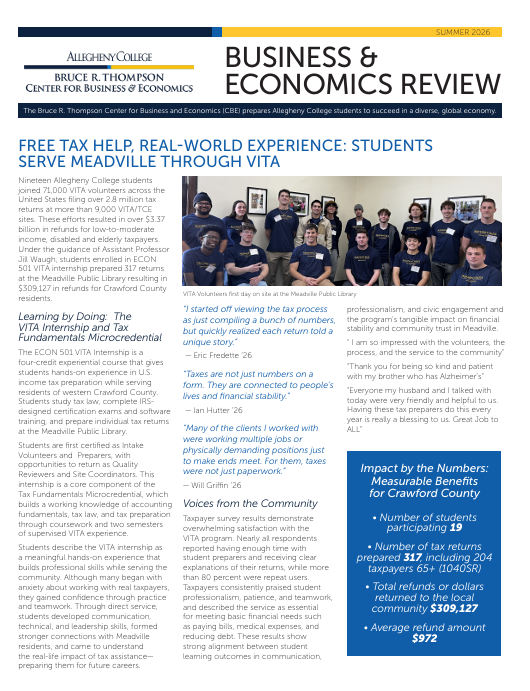 Our Summer 2026 newsletter is now available with stories of student achievement, community engagement, faculty excellence, entrepreneurship, and alumni success. From helping local taxpayers through the VITA program to competing in the Zingale Big Idea Competition and presenting research at the Federal Reserve, our students continue to make a difference both on and off campus.